Home / Internships & first job
Can international students work in the USA? On-campus jobs, CPT and OPT
The ways an F-1 student can work in the US: on-campus jobs, hardship permission, CPT and OPT, with the 20-hour limit and the official pages that set each rule.

On this page
Yes, international students on an F-1 visa can work in the United States, but only in a few set ways and only with the right permission. Work without permission ends your student status.
The Department of Homeland Security (DHS) is blunt about it. Its Study in the States site says the government “takes working illegally very seriously”. If your designated school official (DSO) knows you are working without permission, they must report it in SEVIS. Your record is then terminated, you have to leave the United States immediately, and you may not be allowed to return (Study in the States, Working in the United States (opens in a new tab), checked 18 Oct 2026).
So the first step is always the same: talk to your DSO before you accept any job. This guide covers F-1 students at colleges and universities. M-1 and J-1 students have different rules.
The four ways an F-1 student can work
| Type | Where | Hours while school is in session | Who approves | Need an EAD? |
|---|---|---|---|---|
| On-campus employment | On campus, or at an off-campus site educationally affiliated with the school | Up to 20 a week | Your school, through your DSO | No |
| Severe economic hardship | Off campus, any job | Up to 20 a week | DSO recommends; USCIS approves | Yes |
| Curricular practical training (CPT) | A named employer, as part of your curriculum | Part-time or full-time | Your DSO | No |
| Optional practical training (OPT) | Any job directly related to your major | Up to 20 a week before you finish; at least 20 after | DSO recommends; USCIS approves | Yes |
Sources: Study in the States (opens in a new tab) and 8 CFR 214.2(f)(9) and (f)(10) (opens in a new tab), checked 18 Oct 2026. EAD means Employment Authorization Document, the card that USCIS issues.
On-campus jobs
On-campus employment is the easiest to get, because you do not apply to U.S. Citizenship and Immigration Services (USCIS). Study in the States gives two examples: a job at the university bookstore or in the cafeteria.
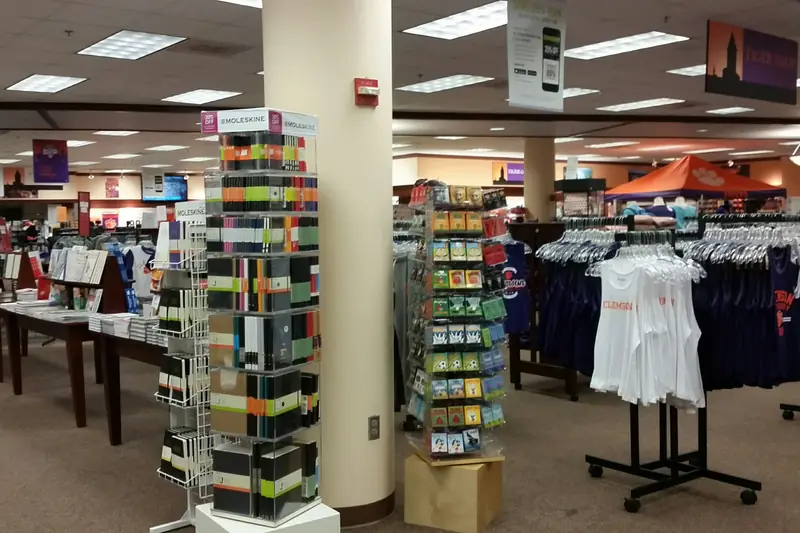
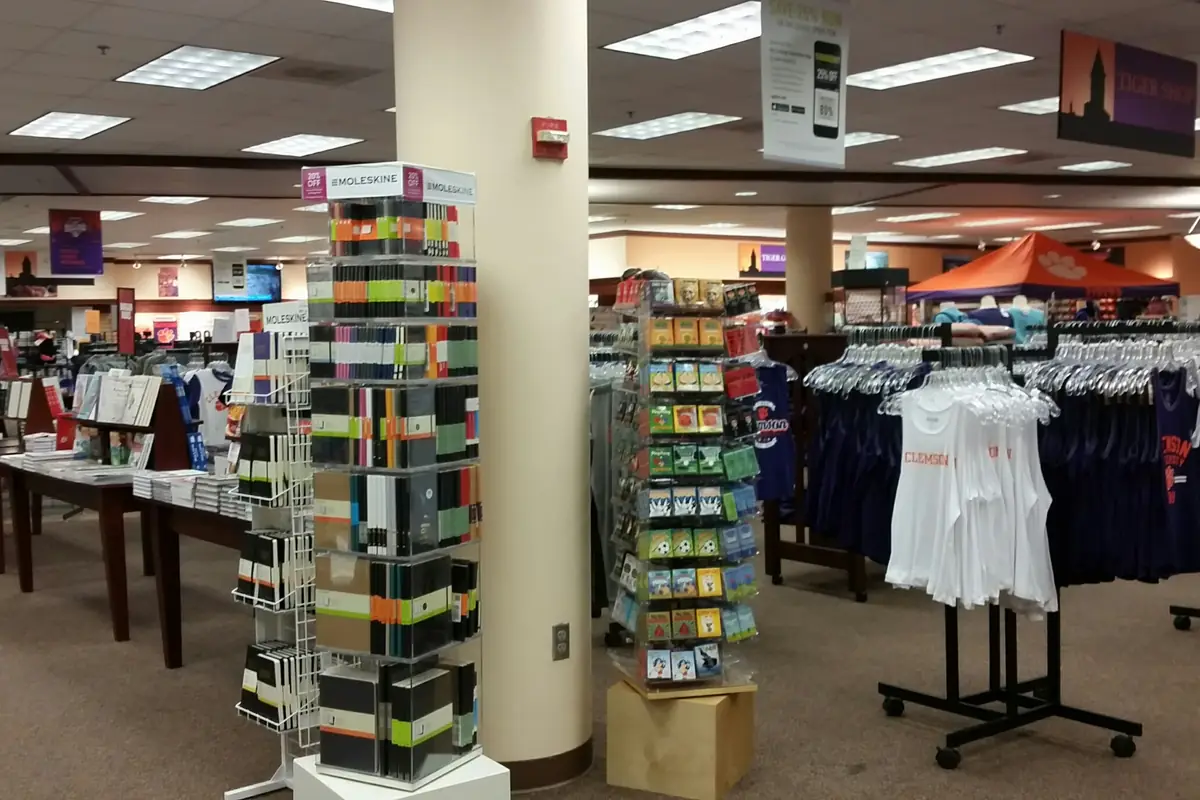
Fig. 1 A campus bookstore Photo: Madamebookmaster, Wikimedia Commons (opens in a new tab), CC BY-SA 4.0 (opens in a new tab), cropped to 3:2, resized, converted to WebP.
The regulation draws the line more precisely (8 CFR 214.2(f)(9)(i) (opens in a new tab), checked 18 Oct 2026):
- On the school’s premises. This includes commercial firms on campus that serve students, such as the bookstore or cafeteria.
- Not every firm on campus counts. A construction company putting up a school building does not give on-campus employment, because it does not serve students directly.
- At an off-campus site, only with an educational link. The link must come from the school’s established curriculum or from contract-funded research at postgraduate level.
How many hours
While school is in session, you may not work more than 20 hours a week on campus. When school is not in session, or during your annual vacation, you may work full-time on campus (8 CFR 214.2(f)(9)(i) (opens in a new tab), checked 18 Oct 2026). The rule sets the limit for on-campus employment as a whole, not for each job. If you hold two campus jobs, ask your DSO how your school counts the hours.
When you can start and stop
Students whose SEVIS status is Active may apply for on-campus jobs up to 30 days before classes begin. You talk to your DSO, get an approval letter, and use it with a letter from your employer to apply for a Social Security Number (SSN). Every student who works needs an SSN (Study in the States (opens in a new tab), checked 18 Oct 2026).
On-campus work ends when you complete your course of study. The exception is a student who will continue at the same school in a new programme the next term. After you finish, the only work open to you is practical training (8 CFR 214.2(f)(9)(i) (opens in a new tab)).
Fig. 2 F-1 weekly hour limits in term Source: 8 CFR 214.2(f), checked 18 Oct 2026 (opens in a new tab)
Off-campus work for severe economic hardship
Off-campus work outside practical training is rare. It is open only to students who have completed at least one full academic year and are in good academic standing. You must face severe economic hardship caused by circumstances beyond your control (8 CFR 214.2(f)(9)(ii) (opens in a new tab), checked 18 Oct 2026). The regulation names examples:
- loss of financial aid or of on-campus employment, through no fault of yours;
- large changes in currency value or the exchange rate;
- steep rises in tuition or living costs;
- unexpected changes in the finances of the person who supports you.
You explain the hardship to your DSO. If the DSO agrees, they recommend you and give you an updated Form I-20. You then file Form I-765 with USCIS within 30 days of the recommendation. You cannot start work while the I-765 is pending: you wait for the EAD (Study in the States (opens in a new tab), checked 18 Oct 2026). The limit is 20 hours a week while school is in session, and full-time during holidays and vacations.
Curricular practical training (CPT)
CPT is work, such as an internship or a cooperative education placement, that is an integral and required part of your curriculum. Your DSO authorises it in SEVIS for a named employer, and you start on the date on your endorsed Form I-20. There is no USCIS application.
Practical training is usually open after one full academic year of full-time study. Graduate programmes that require immediate practical training are the exception (8 CFR 214.2(f)(10) (opens in a new tab), checked 18 Oct 2026). In August 2026, the Student and Exchange Visitor Program reminded schools that CPT must be required for every student in the curriculum. The full comparison is in CPT vs OPT.
Optional practical training (OPT)
OPT is work directly related to your major. You can do up to 12 months at each degree level, before you finish (pre-completion), after you finish (post-completion), or split between the two. Pre-completion OPT is capped at 20 hours a week while school is in session. Post-completion OPT must be at least 20 hours a week (USCIS, OPT for F-1 Students (opens in a new tab), checked 18 Oct 2026). Since 15 September 2026, you must file for post-completion OPT no later than 30 days after your programme end date (8 CFR 214.2(f)(11) (opens in a new tab)).
If your degree is on the DHS STEM list, you may apply for a 24-month STEM OPT extension. Your employer must use E-Verify, and the two of you sign a training plan, Form I-983.
The unemployment limit
Post-completion OPT keeps your F-1 status only while you work. You may not build up more than 90 days of unemployment in total during post-completion OPT. If you get the 24-month STEM extension, the limit is 150 days across the whole OPT period (8 CFR 214.2(f)(10)(ii)(E) (opens in a new tab), checked 18 Oct 2026).
Fig. 3 Unemployment allowed on OPT, in total Source: 8 CFR 214.2(f)(10), checked 18 Oct 2026 (opens in a new tab)
Rules that changed in 2026
Two federal rules from 2026 affect working students. Check each one with your DSO.
- Fixed admission period, in force from 15 September 2026. F-1 students are now admitted for a fixed period, the length of the programme up to 4 years, instead of “duration of status”. After your programme or your OPT ends, you have 30 days to leave or to take steps to stay, down from 60. Students who were in F-1 status for duration of status on 15 September 2026 keep a 60-day period under the transition rule (8 CFR 214.1(m) (opens in a new tab)). DHS says students who choose post-completion OPT will probably need an extension of stay or a new admission (Federal Register, 17 July 2026 (opens in a new tab); current rule at 8 CFR 214.2(f)(5) (opens in a new tab), checked 18 Oct 2026).
- Proposed OPT fees, not in force. On 8 October 2026, DHS proposed that schools pay $70,000 for a student’s initial OPT and $30,000 for each later OPT. Comments close on 9 November 2026. Until a final rule appears, no such fee applies (Federal Register, 8 October 2026 (opens in a new tab), checked 18 Oct 2026).
Fig. 4 Federal rules on F-1 students, 2026 Source: Federal Register, checked 18 Oct 2026 (opens in a new tab)
Questions students ask
How many hours can international students work in the USA? Up to 20 hours a week while school is in session, for on-campus jobs, hardship permission and pre-completion OPT. Full-time is allowed during official breaks for those types. CPT can be full-time, and post-completion OPT must be at least 20 hours a week.
Can I work off campus in my first year? Generally no. Hardship permission and practical training both need one full academic year first. The exception is CPT in a graduate programme that requires immediate practical training.
Can I do freelance or online work for a company abroad? The pages we checked do not address this case directly. Ask your DSO before you take any paid work.
What is the 5-month rule? It is about travel, not work. A student returning from a temporary absence of five months or less may be readmitted with a current, properly endorsed Form I-20 (8 CFR 214.2(f)(4) (opens in a new tab), checked 18 Oct 2026). If you plan to be away longer, ask your DSO first.
Can I switch from F-1 to a green card? This guide does not cover permanent residence. That is an individual immigration question. Ask an immigration lawyer or an accredited representative.
Before you act
This guide is general information, not legal advice. Your DSO approves on-campus work, authorises CPT and recommends OPT, so ask them first, and keep every letter and endorsed I-20. If your case is not simple, talk to an immigration lawyer. Our disclaimer lists who may give immigration advice in each country.
Studying in the UK, Canada or Australia instead? See working while you study for the hour limits there.
Sources
All checked on 18 October 2026. Study in the States, USCIS and ICE blocked our requests, so we read their pages from copies archived between 9 September and 12 October 2026.
- Study in the States (DHS), Working in the United States (opens in a new tab), last updated 28 November 2023.
- Study in the States (DHS), Applying for Practical Training (opens in a new tab), last updated 24 August 2026.
- USCIS, Optional Practical Training (OPT) for F-1 Students (opens in a new tab), last updated 25 November 2024.
- Electronic Code of Federal Regulations, 8 CFR 214.2 (opens in a new tab), paragraphs (f)(4), (f)(5), (f)(9) and (f)(10).
- Federal Register, Establishing a Fixed Time Period of Admission (opens in a new tab), 17 July 2026.
- Federal Register, Optional Practical Training Fees (proposed rule) (opens in a new tab), 8 October 2026.
General information, not legal, immigration or financial advice. Rules change. Confirm every requirement on the official page, and talk to a licensed adviser if your case is not simple. Disclaimer