Home / Internships & first job
CPT vs OPT: what each work permission allows
CPT and OPT compared for F-1 students: who authorises each, the filing windows, the hour limits, and how one affects the other. Checked against DHS and USCIS pages.

On this page
CPT and OPT are the two kinds of practical training open to F-1 students in the United States. Both let you work in your field. They differ in who approves them, when you can use them, and what they cost you later.
The short version: CPT (curricular practical training) is work that your degree requires, and your school’s designated school official (DSO) authorises it. OPT (optional practical training) is work that your degree does not require. Your DSO recommends it, and U.S. Citizenship and Immigration Services (USCIS) must approve it before you start.
Neither one changes your immigration status. The Department of Homeland Security (DHS) says that F students do not need to change status to do practical training. They work with their DSO and get the right authorisation first (Study in the States, Applying for Practical Training (opens in a new tab), checked 18 Oct 2026).
CPT and OPT side by side
| CPT | OPT | |
|---|---|---|
| What it is | Work or an internship that is an integral part of your curriculum | Work directly related to your major, not required by your programme |
| Who approves it | Your DSO, in SEVIS | Your DSO recommends it; USCIS approves it |
| Form to USCIS | None | Form I-765, with a fee |
| Proof you can work | Form I-20 endorsed for CPT | Employment Authorization Document (EAD) |
| When | During your programme | Before (pre-completion) or after (post-completion) your programme end date |
| Hours | Part-time or full-time | Up to 20 hours a week in term if pre-completion; at least 20 hours a week if post-completion |
| Employer | A named employer with a cooperative agreement with your school | Any job directly related to your major |
| Length | No fixed maximum in the rule; 12 months or more full-time ends OPT eligibility | Up to 12 months per degree level |
Sources: Study in the States (opens in a new tab), ICE, Practical Training (opens in a new tab) and USCIS, OPT for F-1 Students (opens in a new tab), all checked 18 Oct 2026. The regulation is 8 CFR 214.2(f)(10) (opens in a new tab).
What CPT is
The regulation defines CPT as “alternative work/study, internship, cooperative education or any other type of required internship or practicum” that employers offer through cooperative agreements with the school (8 CFR 214.2(f)(10)(i) (opens in a new tab), checked 18 Oct 2026). The key word is required. CPT must be an integral part of an established curriculum.
To get CPT, you follow your school’s process and ask your DSO. If you qualify, the DSO authorises CPT with a specific employer in SEVIS, the Student and Exchange Visitor Information System. You then get a Form I-20 endorsed for CPT. You do not file anything with USCIS. You may start work on or after the CPT start date on that I-20 (Study in the States (opens in a new tab), checked 18 Oct 2026).
Because the DSO names an employer, you need the offer before you ask for CPT. Find out early which office at your school handles CPT requests, and what it needs from you and the employer.
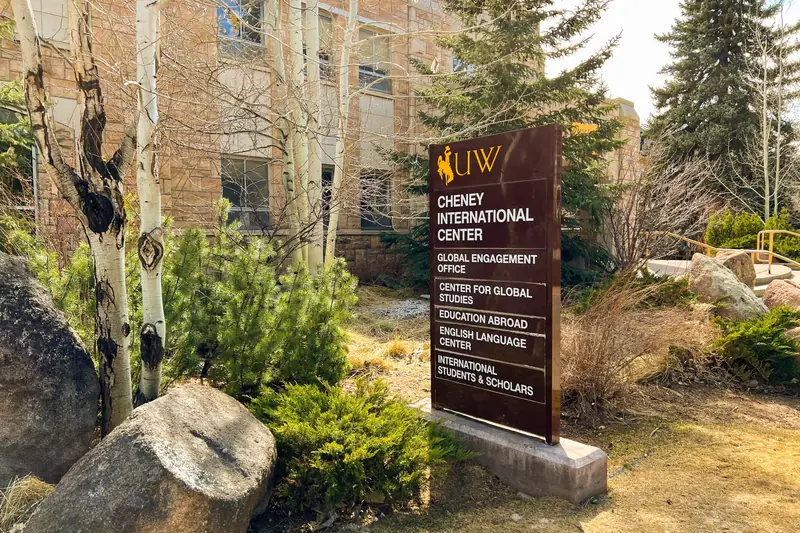
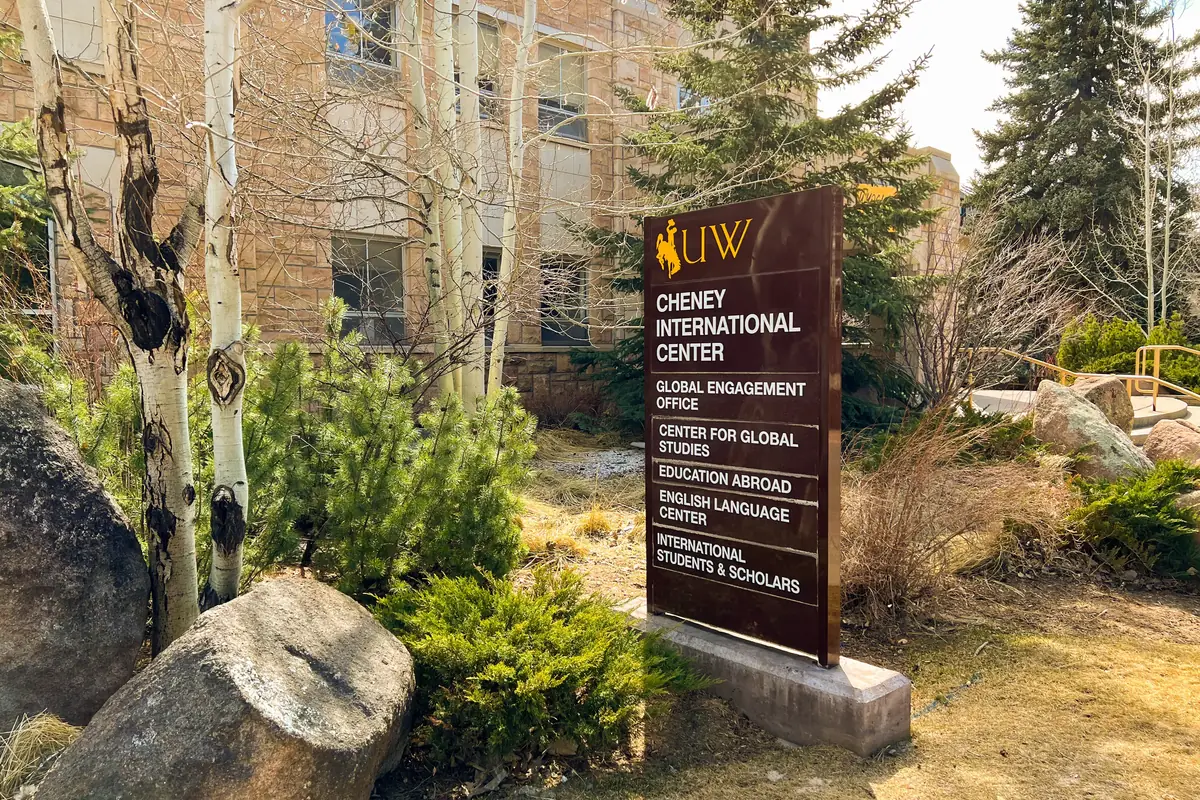
Fig. 1 International centre sign, University of Wyoming Photo: Tony Webster, Wikimedia Commons (opens in a new tab), CC BY 2.0 (opens in a new tab), cropped to 3:2, resized, converted to WebP.
When you can start CPT
Practical training is open to students who have been enrolled full-time for one full academic year. The rule has one exception for CPT: graduate programmes that require immediate participation in practical training (8 CFR 214.2(f)(10) (opens in a new tab), checked 18 Oct 2026). Immigration and Customs Enforcement (ICE) puts it this way: at the graduate level, your DSO may authorise CPT in your first semester if your programme requires it (ICE (opens in a new tab), checked 18 Oct 2026).
The August 2026 CPT guidance
On 24 August 2026, the Student and Exchange Visitor Program (SEVP) sent schools Broadcast Message 2608-02 (opens in a new tab) on CPT (checked 18 Oct 2026). It says SEVP saw a rise in CPT authorisations that appear to break the rules. Its main points:
- CPT must be required for all students in that curriculum, foreign and American alike.
- An elective course does not meet the test. If the course is optional, the CPT is optional, and the integral and required aspects of CPT are not met.
- Students must make an official request to their DSO. CPT runs through employers with cooperative agreements with the school.
The broadcast states that it is not a rule. Still, it tells you how SEVP reads the existing rule. If a school offers CPT “from day one” or as an option, ask your DSO how the placement meets the rule.
What OPT is
OPT is temporary employment directly related to your major. You can use it before you complete your studies (pre-completion), after you complete them (post-completion), or both. USCIS can authorise up to 12 months of OPT for each higher degree level: 12 months for a bachelor’s degree, for example, and another 12 months for a master’s degree (USCIS (opens in a new tab), checked 18 Oct 2026).
The hour rules differ by type:
- Pre-completion OPT: 20 hours or less a week while school is in session. Full-time when school is not in session.
- Post-completion OPT: at least 20 hours a week, part-time or full-time.
OPT has two approvals. Your DSO recommends it in SEVIS and gives you a Form I-20 endorsed for OPT. You then file Form I-765 with USCIS, with the fee and documents. You can start work only when USCIS has approved the I-765, you hold the EAD, and the start date on the EAD has arrived (Study in the States (opens in a new tab), checked 18 Oct 2026). The fee is listed on the USCIS fee schedule (opens in a new tab).
Fig. 2 How CPT and OPT are approved Source: Study in the States, checked 18 Oct 2026 (opens in a new tab)
The OPT filing window
Timing matters more for OPT than for CPT, because USCIS must receive your application inside a window. For post-completion OPT, the rules set these dates (checked 18 Oct 2026). Study in the States still showed 60 days in its last copy we could read, from before the change, so confirm the date with your DSO:
- 90 days before your programme end date: the earliest date you can file Form I-765.
- Within 30 days of the DSO’s recommendation: you must file within 30 days after your DSO enters the recommendation in SEVIS.
- 30 days after your programme end date: the last day you can file Form I-765, and the latest start date you can request (8 CFR 214.2(f)(11) (opens in a new tab), as amended from 15 September 2026).
- 14 months after your programme end date: all post-completion OPT must be complete.
For pre-completion OPT, you may file up to 90 days before you complete a full academic year, as long as the OPT starts after that year is complete.
Fig. 3 Post-completion OPT: the dates that bind you Source: 8 CFR 214.2(f)(11), checked 18 Oct 2026 (opens in a new tab)
How one affects the other
This is where most confusion sits. The rules come from three places, all checked 18 Oct 2026:
- Full-time CPT. If you have 12 months or more of full-time CPT, you cannot get OPT. Part-time CPT does not stop you from doing OPT (ICE (opens in a new tab)).
- Pre-completion OPT. Every period of pre-completion OPT is deducted from the post-completion OPT you have left at the same degree level (USCIS (opens in a new tab)).
- Part-time counts at half rate. USCIS gives two examples. One year of part-time (20 hours a week) pre-completion OPT leaves 6 months of full-time post-completion OPT. One year of full-time pre-completion OPT leaves none.
Fig. 4 OPT left after pre-completion OPT, same degree level Source: USCIS, checked 18 Oct 2026 (opens in a new tab)
So the choice is a trade-off. Early work experience during your degree can shorten the work time you have after you graduate. Ask your DSO to show how a planned CPT or pre-completion OPT period affects your own record.
The STEM OPT extension
If your degree is on the DHS STEM Designated Degree Program List, you may apply for a 24-month extension of post-completion OPT. USCIS lists three conditions: a STEM degree on that list, an employer enrolled in E-Verify, and an initial grant of post-completion OPT based on your STEM degree (USCIS (opens in a new tab), checked 18 Oct 2026).
You and your employer complete Form I-983, the training plan. You can file up to 90 days before your current OPT ends, and within 60 days after your DSO’s recommendation. If USCIS receives your application before your OPT ends, your work permission is extended automatically for up to 180 days while the case is pending (Study in the States (opens in a new tab), checked 18 Oct 2026).
Unemployment is limited. On post-completion OPT, you may not have more than 90 days of unemployment in total. With the STEM extension, the limit is 150 days across the whole OPT period (8 CFR 214.2(f)(10)(ii)(E) (opens in a new tab), checked 18 Oct 2026).
What changed in 2026
Three changes from 2026 touch practical training. Check each one with your DSO.
- A fixed admission period. A DHS final rule, effective 15 September 2026, admits F-1 students for a fixed period instead of “duration of status”. The period is the length of the programme, up to 4 years. DHS says post-completion OPT will “probably” need an extension of stay or a new admission. The same rule moved the last day to file for post-completion OPT from 60 to 30 days after the programme end date. The time to prepare to leave after your programme or OPT ends is now 30 days, down from 60. Students who were in F-1 status for duration of status on 15 September 2026 keep a 60-day departure period under the transition rule (8 CFR 214.1(m) (opens in a new tab)) (Federal Register, 17 July 2026 (opens in a new tab), checked 18 Oct 2026).
- A proposed OPT fee. On 8 October 2026, DHS proposed fees of $70,000 for initial OPT and $30,000 for each later OPT. The school, not the student, would pay before the DSO enters the recommendation. This is a proposed rule, not a final one. Comments close on 9 November 2026 (Federal Register, 8 October 2026 (opens in a new tab), checked 18 Oct 2026).
- Stricter CPT reading. The SEVP broadcast of 24 August 2026, described above.
Questions students ask
Is CPT the same as an internship? Not always. An internship can be CPT only if it is a required, integral part of your curriculum and the employer has a cooperative agreement with your school. An internship outside that can only happen under another authorisation, such as OPT.
Can I do CPT for 2 years? The regulation sets no fixed maximum for CPT. It does say that one year or more of full-time CPT makes you ineligible for post-completion OPT. Each CPT period also has to meet the “integral and required” test.
Is OPT a visa? No. OPT is work permission inside F-1 status. You do not change your status to use it.
Is there a $100,000 fee for OPT? No. As of 18 October 2026, OPT has no such fee. The proposed rule above would set $70,000 and $30,000 fees, paid by schools. For one student who uses OPT twice, that would total $100,000. It is not in force. The proposal links its amount to the payment for H-1B workers under Proclamation 10973 of September 2025.
Before you act
This guide gives general information, not legal advice. Your DSO is the person who authorises CPT and recommends OPT, so start every plan with them. If your case is not simple, talk to an immigration lawyer. See our disclaimer for the advisers each country recognises. This guide does not cover green cards or permanent residence.
For every way an F-1 student can work, including on-campus jobs, read can international students work in the USA.
Sources
All checked on 18 October 2026. Study in the States, USCIS and ICE blocked our requests, so we read their pages from copies archived between 9 September and 12 October 2026.
- Study in the States (DHS), Applying for Practical Training (opens in a new tab), last updated 24 August 2026.
- USCIS, Optional Practical Training (OPT) for F-1 Students (opens in a new tab), last updated 25 November 2024.
- ICE, Practical Training (opens in a new tab), updated 10 December 2024.
- SEVP, Broadcast Message 2608-02: Guidance for DSOs regarding CPT (opens in a new tab), 24 August 2026.
- Electronic Code of Federal Regulations, 8 CFR 214.2 (opens in a new tab).
- Federal Register, Establishing a Fixed Time Period of Admission (opens in a new tab), 17 July 2026.
- Federal Register, Optional Practical Training Fees (proposed rule) (opens in a new tab), 8 October 2026.
General information, not legal, immigration or financial advice. Rules change. Confirm every requirement on the official page, and talk to a licensed adviser if your case is not simple. Disclaimer