Home / Admissions & college choice
Study in Canada: requirements for international students
The study permit requirements for Canada in order: DLI acceptance, PAL or TAL, proof of funds, documents and fees, each from canada.ca with a checked date.
On this page
To study in Canada, you meet two sets of requirements. The first belongs to your school: grades, an English or French score, and its own deadlines. The second belongs to Immigration, Refugees and Citizenship Canada (IRCC), which issues the study permit. Most pages mix the two, along with agent services.
This guide takes the IRCC requirements in the order you meet them, from the school’s letter of acceptance to the online application. Each rule links to the canada.ca page that sets it and was checked on 18 October 2026. Rules change, so check the page again on the day you apply.
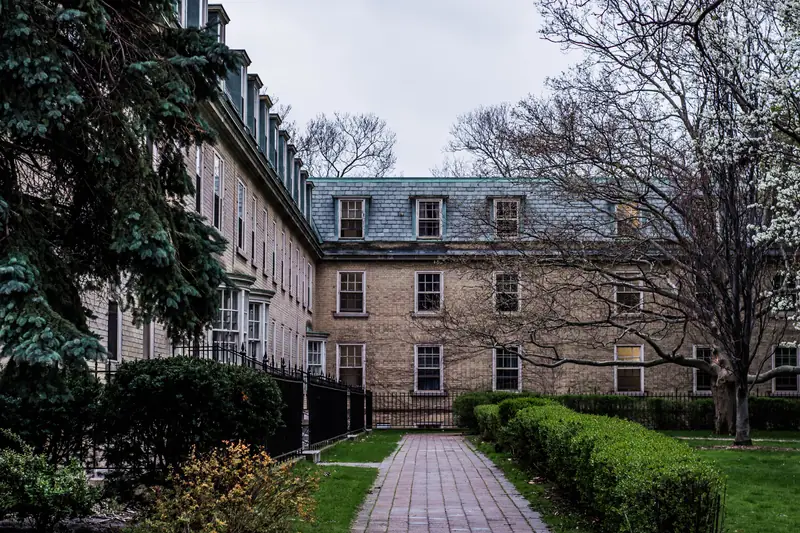
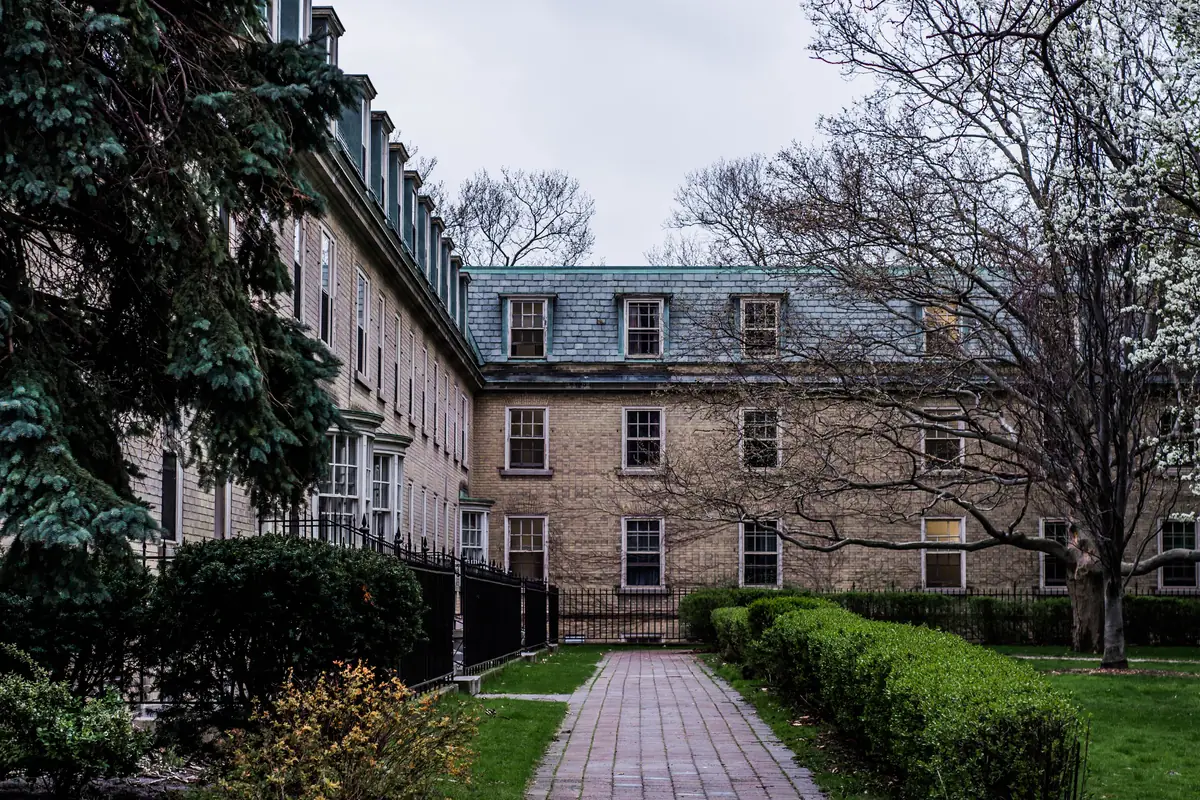
Fig. 1 A quadrangle at the University of Toronto Photo: Victoria Heath, Wikimedia Commons (opens in a new tab), CC0 1.0 (opens in a new tab), resized, converted to WebP.
Who can get a study permit
IRCC’s eligibility page lists the core requirements (IRCC, who can apply (opens in a new tab), page dated 26 January 2026, checked 18 Oct 2026). You can come to Canada to study if you:
- are enrolled at a designated learning institution (DLI);
- prove you have enough money for your tuition, your living expenses and return transport, for yourself and any family members who come with you;
- obey the law, have no criminal record, and get a police certificate if required;
- are in good health, and get a medical exam if required;
- prove to an officer that you will leave Canada when your study permit expires.
Once you are in Canada, you must make progress in your program and respect the conditions on your permit.
The requirements in order
The IRCC page “Get the right documents” sets out what you upload with your application (IRCC, get the right documents (opens in a new tab), page dated 6 October 2026, checked 18 Oct 2026). Here they are in the order you collect them:
Fig. 2 The study permit file in the order you build it Source: IRCC, checked 18 Oct 2026 (opens in a new tab)
1. A letter of acceptance from a DLI
You need a letter of acceptance from a DLI in every case, except some family members of approved permit holders. All primary and secondary schools in Canada are DLIs. Post-secondary DLIs are on IRCC’s list, which also shows which schools offer programs eligible for a post-graduation work permit (IRCC, DLI list (opens in a new tab), page dated 5 October 2026, checked 18 Oct 2026). Write the school’s DLI number on your application.
For post-secondary students, IRCC asks your school to confirm that your letter is valid. If the school does not respond by the deadline, IRCC returns your application and refunds the processing fee. Ask your school to confirm it will validate the letter.
2. A provincial or territorial attestation letter (PAL or TAL)
Most applicants also need a PAL or TAL. The province or territory where you will study issues it through your school, and it confirms that you have one of the study places available there (IRCC, PAL or TAL (opens in a new tab), page dated 2 September 2026, checked 18 Oct 2026).
- In most cases, you must accept your offer and pay part or all of your tuition before the school issues it.
- Submit it with your study permit application, not after.
- Each applicant needs one, even when a family applies together.
- In Quebec, you need a Quebec Acceptance Certificate (CAQ) instead.
The PAL or TAL has a short life. Unless it shows an earlier expiry date, one issued in 2026 is valid until 31 December 2026. It must be valid on the day you apply, but not on the day you start studying.
Fig. 3 How long a 2026 PAL or TAL stays valid Source: IRCC, checked 18 Oct 2026 (opens in a new tab)
You cannot reuse a PAL or TAL after IRCC approves or refuses your application. Since 22 January 2025, you also need a new one when you change schools.
3. Proof of funds
You must prove that you can pay, without working in Canada, for three things: your tuition, your living expenses, and transport to and from Canada, for you and any family members who come with you (IRCC, proof of financial support (opens in a new tab), page dated 28 August 2026, checked 18 Oct 2026). You show funds for the first year. For a program longer than a year, you also explain how you will pay for the rest, for example with a multi-year scholarship.
The living-expense amount depends on your family size and on when you apply. It does not include tuition or transport:
Fig. 4 Yearly living-expense funds outside Quebec, CAD Source: IRCC, checked 18 Oct 2026 (opens in a new tab)
So a student coming alone who applies on or after 1 September 2026 shows CAD 23,448 for living expenses, plus first-year tuition, plus transport. For more than 7 people, IRCC adds CAD 6,318 for each extra family member.
IRCC lists examples of documents that can prove funds. You do not need all of them, but together they must cover every cost:
- proof you paid first-year tuition and housing, such as a receipt from your DLI, together with other proof for living costs and transport;
- a student or education loan from a bank;
- a scholarship, or a Government of Canada-funded program; a tuition-only scholarship still needs separate proof for living costs and transport;
- a guaranteed investment certificate (GIC) from a Canadian financial institution;
- your bank statements for the past 6 months, including the month you apply or the month before, with documents that show where the money came from;
- a letter from the person or institution giving you money, with their occupation, relationship to you, number of dependants and the amount, plus their identification.
If your country uses foreign exchange controls, you must also prove you will be allowed to take the money out. For a closer look at funds in four countries, see our guide to proof of funds for a student visa.
4. Identity documents
You need a copy of a valid passport or travel document for you and each family member who comes with you. Upload the information page when you apply online. You also need 2 recent passport-size photos, with the person’s name and date of birth written on the back. If IRCC approves you, you send your original passport.
5. A letter of explanation (recommended)
IRCC recommends a letter that explains why you want to study in Canada and shows that you understand your responsibilities as a student. Keep it factual and consistent with the rest of your file.
6. Medical exam, police certificate and local documents
You may need a medical exam if you plan to stay more than 6 months, recently spent time in certain countries, or plan to work in certain jobs that protect public health. IRCC may ask for a police certificate, so apply early if you think you need one. Children under 17 who come without a parent or legal guardian need an appointed custodian. Your local visa office may ask for more documents; find them on the “How to apply” page under your country.
How to apply, and what it costs
You must apply online, whether you are outside Canada or already in it. Paper applications are only for people with a disability that prevents online applying, or with certain identity or travel documents (IRCC, how to apply (opens in a new tab), page dated 2 September 2026, checked 18 Oct 2026). Upload as many documents as you can at once: IRCC says that waiting to submit documents delays processing.
| Fee | Amount | Source |
|---|---|---|
| Study permit, including extensions, per person | CAD 150 | IRCC fee list (opens in a new tab) |
| Biometrics, per person | CAD 85 | IRCC biometrics (opens in a new tab) |
| Biometrics, family applying at the same time | CAD 170 maximum | IRCC biometrics (opens in a new tab) |
Both checked 18 Oct 2026. Biometrics are your fingerprints and photo. Most applicants for temporary residence give them; US nationals, children under 14 and applicants over 79 are among the exemptions.
How long does it take? Times change, so IRCC publishes them in a processing times tool (opens in a new tab) rather than as a fixed number. Check it before you set your dates.
Do you need IELTS for a Canada study permit?
IRCC’s list of study permit documents does not include an English or French test. Your school sets its own language requirement for admission, so check the school’s page.
A test can matter later. If you hope to work in Canada after you graduate, the post-graduation work permit (PGWP) needs proof of English or French at CLB 7 for university programs or CLB 5 for college programs, from a short list of tests (IRCC, PGWP eligibility (opens in a new tab), page dated 24 June 2026, checked 18 Oct 2026). Our guide to IELTS vs TOEFL shows which tests count.
Can you work while you study?
You can work off campus without a work permit if you meet all of IRCC’s conditions (IRCC, work off campus (opens in a new tab), page dated 15 April 2026, checked 18 Oct 2026). The main ones:
- you are a full-time student at a DLI and have started your program;
- your program is post-secondary (or secondary-level vocational in Quebec), at least 6 months long, and leads to a degree, diploma or certificate;
- your study permit shows conditions that allow off-campus work;
- you have a social insurance number (SIN).
The permit condition reads “May work 24 hours per week off campus”. IRCC counts any time you spend earning wages or a commission. Remote work for an employer outside Canada does not count towards the 24 hours, as long as you meet your permit conditions. Do not plan your budget around work income: IRCC asks for proof of funds without working in Canada.
After your studies
IRCC notes that PGWP eligibility depends on several things, including when you submit your study permit application. If you submitted it on or after 1 November 2024, graduates of college programs and of university programs other than bachelor’s, master’s or doctoral degrees must have studied in an eligible field. Before you apply, check whether your DLI offers PGWP-eligible programs.
Questions about permanent residence after study are individual immigration questions. This guide does not answer them. Read the IRCC pages and, for your own case, talk to a licensed immigration consultant or lawyer.
Common mistakes
- Applying with an expired PAL. A PAL from a previous cap year is not accepted, even if your course starts later.
- Counting a tuition-only scholarship as living costs. You still need separate proof for living costs and transport.
- Forgetting transport. The funds rule covers travel to and from Canada.
- Bank statements without a source. IRCC asks for documents that show where the money came from.
- Uploading other documents in the letter of acceptance slot. IRCC says doing so gives consent to share them with your school.
- Using an agent’s figure. Amounts change each year; take them from canada.ca on the day you apply.
Checklist before you apply
- Confirm your school is a DLI and note its DLI number.
- Accept your offer and pay the deposit the school asks for.
- Get your PAL or TAL (or CAQ in Quebec) and check its expiry date.
- Work out your total: tuition, living expenses for your family size, and transport.
- Collect proof of funds, including 6 months of statements and the source of the money.
- Prepare your passport copy, 2 photos and a letter of explanation.
- Read your local visa office instructions.
- Apply online, pay CAD 150 plus CAD 85 for biometrics, and book your biometrics appointment.
This guide is general information, not immigration advice. If your case is not simple, talk to a licensed immigration consultant or lawyer. See our disclaimer.
Sources
- Study permit: who can apply (opens in a new tab), IRCC. Page dated 26 January 2026, checked 18 October 2026.
- Study permit: get the right documents (opens in a new tab), IRCC. Page dated 6 October 2026, checked 18 October 2026.
- Provincial or territorial attestation letter (opens in a new tab), IRCC. Page dated 2 September 2026, checked 18 October 2026.
- Proof of financial support (opens in a new tab), IRCC. Page dated 28 August 2026, checked 18 October 2026.
- Designated learning institutions list (opens in a new tab), IRCC. Page dated 5 October 2026, checked 18 October 2026.
- Study permit: how to apply (opens in a new tab), IRCC. Page dated 2 September 2026, checked 18 October 2026.
- Fee list (opens in a new tab) and biometrics (opens in a new tab), IRCC. Checked 18 October 2026.
- Work off campus as an international student (opens in a new tab), IRCC. Page dated 15 April 2026, checked 18 October 2026.
- Post-graduation work permit: who can apply (opens in a new tab), IRCC. Page dated 24 June 2026, checked 18 October 2026.
- Check processing times (opens in a new tab), IRCC. Checked 18 October 2026.
General information, not legal, immigration or financial advice. Rules change. Confirm every requirement on the official page, and talk to a licensed adviser if your case is not simple. Disclaimer