Home / Admissions & college choice
UK grading system explained for international applicants
How UK degree classes, master's grades and A levels work, and how two UK universities convert US GPA, Indian percentages and Nigerian classes to a 2:1.

On this page
The UK grading system looks simple from the outside: a First, a 2:1, a 2:2 and a Third. For an international applicant, the hard part is the other direction. A UK course asks for “a 2:1 or equivalent”, and you hold a US GPA, an Indian percentage or a Nigerian class of degree. What counts as equivalent?
There is no single national answer. Each UK university publishes its own conversion table, and two universities can set different lines for the same 2:1. This guide explains the UK grades first, then shows what two universities’ own pages ask for, with a worked example for each origin. Every figure was checked on 18 October 2026 and links to its source.
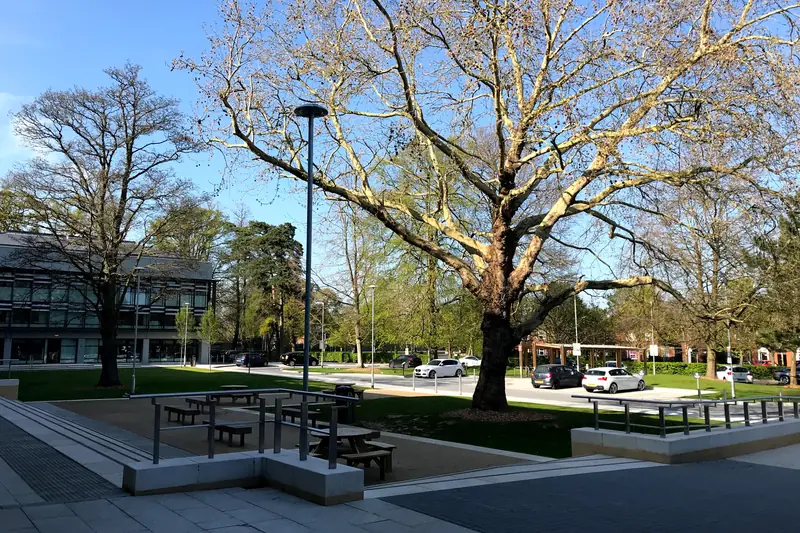
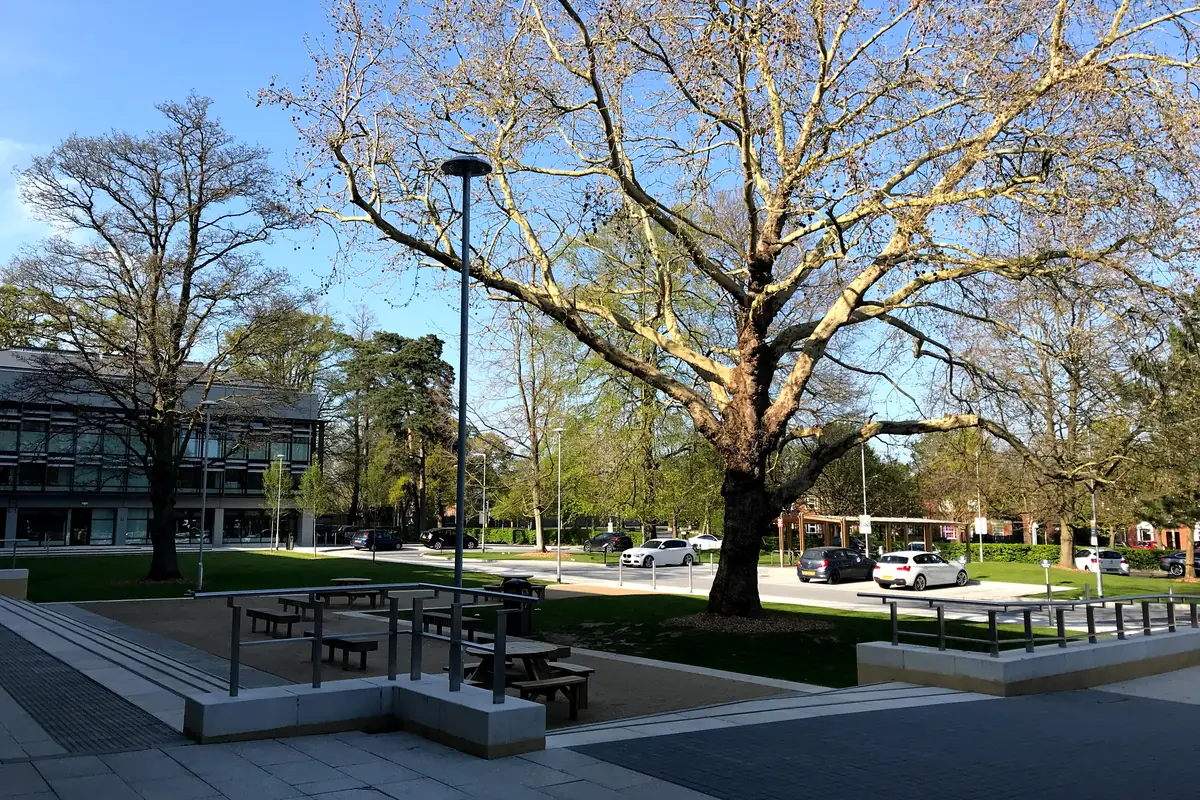
Fig. 1 Oxford Brookes University campus, Oxford Photo: -wuppertaler, Wikimedia Commons (opens in a new tab), CC BY-SA 4.0 (opens in a new tab), cropped to 3:2, resized, converted to WebP.
The UK grading system in one table
| Stage | How it is graded | Example of a typical entry requirement |
|---|---|---|
| A levels (school) | Letter grades A* to E per subject, often added up as UCAS Tariff points | “AAA” or “128 UCAS points” |
| Bachelor’s degree (honours) | Degree classes: First, Upper Second (2:1), Lower Second (2:2), Third | “A 2:1 or equivalent” for a master’s |
| Taught master’s degree | Distinction, Merit or a pass | A master’s grade is often asked for by research degrees (PhD) |
The percentage lines behind each class are set by each university in its own regulations. The numbers in this guide come from named universities, so you can see real examples rather than an average.
A levels and UCAS Tariff points
A levels are graded per subject from A* (highest) to E. Course pages often state the entry requirement in UCAS Tariff points rather than grades; UWE says it uses the Tariff “like most universities”. The Tariff turns each grade into a number, so different qualifications can be compared. The University of the West of England (UWE Bristol) publishes the A level values (UWE, UCAS Tariff points (opens in a new tab), checked 18 Oct 2026):
Fig. 2 UCAS Tariff points for one A level, by grade Source: UWE Bristol, checked 18 Oct 2026 (opens in a new tab)
So three A grades (AAA) add up to 144 points, which is how Oxford Brookes University labels it: “AAA (144 points)”. An AS level is worth less: UWE lists 20 points for an AS grade A, down to 6 for an E.
If you did not take A levels, the university converts your school qualification. Oxford Brookes, for example, treats a US High School Diploma with a 3.2 GPA plus an SAT of 1270, an ACT of 29, or three AP exams at grades 5, 5 and 4 as equivalent to AAA (Oxford Brookes, USA entry requirements (opens in a new tab), checked 18 Oct 2026). Its minimum for undergraduate entry is a High School Diploma with a 3.0 GPA. A few more rows from the same table show how the line moves:
| A level offer | Oxford Brookes equivalent for a US applicant |
|---|---|
| AAA (144 points) | Diploma with GPA 3.2, plus SAT 1270, ACT 29 or three APs at 5, 5, 4 |
| ABB (128 points) | Diploma with GPA 3.0, plus SAT 1190, ACT 28 or three APs at 5, 4, 4 |
| BBB (120 points) | Diploma with GPA 3.0, plus SAT 1150, ACT 28 or three APs at 4, 4, 4 |
| CCC (96 points) | Diploma with GPA 3.0, plus SAT 1090, ACT 26 or three APs at 3, 3, 3 |
Read the right column as one of three routes: the GPA plus a test score, or the GPA plus AP results. For Nigerian applicants, it maps WAEC or NECO grade B3 to a GCSE grade B or grade 5, and C6 to a GCSE grade C or grade 4.
Bachelor’s degree classes
A UK bachelor’s degree with honours is awarded in classes. Loughborough University publishes the minimum programme mark for each one (Loughborough, classifications (opens in a new tab), checked 18 Oct 2026):
| Class | Short form | Minimum programme mark at Loughborough |
|---|---|---|
| First Class | First | 70% |
| Second Class, Upper Division | 2:1 | 60% |
| Second Class, Lower Division | 2:2 | 50% |
| Third Class | Third | 40% |
Fig. 3 Class lines by programme mark Source: Loughborough University, checked 18 Oct 2026 (opens in a new tab)
How the final mark is worked out
The class depends on a weighted average of your module marks, not on one exam. The method is set by each university. At Loughborough:
- you need a module mark of at least 40% to gain credit in an undergraduate module;
- you need at least 100 credits to pass each year and qualify for an Honours degree;
- your first-year marks do not count towards the class;
- the marks of each later year form a Part Mark, and the Part Marks are weighted and combined into the Programme Mark that decides your class.
Other universities weight the years differently. When you compare UK courses, the class lines may look the same while the calculation behind them differs.
Is 69.5% a First?
It depends on the university’s regulations, so no general rule answers it. Loughborough’s page says the programme board has the discretion to lower any threshold by 2 percentage points, and it points to its Regulation XX for the details. Other universities use their own rounding or borderline rules. If you are close to a line, read your own university’s regulations or ask your department.
What “with honours” means
The classes above are the classes of an honours degree. At Loughborough, as shown above, you qualify for an Honours degree by passing at least 100 credits each year. The exact credit rules differ by university and by programme.
Master’s grades
Taught master’s degrees use different words and a higher module pass mark. At Loughborough:
- you need a module mark of at least 50% to gain credit in a postgraduate taught module;
- you need at least 150 credits, with the other module marks at 40% or above, to qualify for a master’s degree;
- with 180 credits, a Programme Mark of 70% or above gives a Distinction, and 60% or above gives a Merit;
- the programme board may lower these thresholds by 2 points, as for bachelor’s degrees.
Postgraduate diplomas and certificates follow different rules, in Loughborough’s Regulation XXI.
Converting your grades: what UK admissions pages ask for
This is the part most guides skip. A UK master’s course usually asks for a bachelor’s degree “equivalent to a UK 2:1”. Universities do not share one conversion table. Here is what two of them publish for the same requirement:
| Your degree | Oxford Brookes: 2:1 for direct entry | University of Bristol: 2:1 for a master’s |
|---|---|---|
| US bachelor’s | GPA 2.8 | CGPA 3.3 or above |
| Indian bachelor’s | 55%, 60% or 65%, depending on the type of university (see Fig. 5) | A minimum GPA of 6/10 or 60% “will be considered”; the requirement depends on your university and programme |
| Nigerian bachelor’s | Second class (upper division), 60%, GPA 3.50 | A degree equivalent to a 2:1, from a programme accredited by the National Universities Commission (NUC) for at least 50% of your studies |
Sources: Oxford Brookes country pages for the USA (opens in a new tab), India (opens in a new tab) and Nigeria (opens in a new tab); University of Bristol country pages for the USA (opens in a new tab), India (opens in a new tab) and Nigeria (opens in a new tab). All checked 18 Oct 2026.
Fig. 4 US GPA that meets a 2:1, two universities Source: Brookes, Bristol, checked 18 Oct 2026 (opens in a new tab)
Two things stand out. First, the same “2:1” means a US GPA of 2.8 at one university and 3.3 at the other. Second, Oxford Brookes sets a different line for Indian degrees depending on where you studied:
Fig. 5 Indian marks for a 2:1 or a 2:2 Source: Oxford Brookes University, checked 18 Oct 2026 (opens in a new tab)
Worked examples
These examples apply the published lines. They are not a prediction of any decision, because each course can ask for more, and the admissions team reads your whole application.
- US applicant, GPA 3.0. Above the Oxford Brookes line for a 2:1 (2.8). Below the Bristol line (3.3). The same transcript meets one university’s minimum and misses the other’s.
- Indian applicant, 62% from a state university. Above the Oxford Brookes 2:1 line for a Central or State University (60%). At Bristol, 60% is the stated minimum to be considered, and the requirement still depends on the university and programme. Bristol also asks Indian applicants to complete a qualification check with its partner before it issues a CAS.
- Nigerian applicant, second class (upper division). Oxford Brookes lists this class, with 60% or a GPA of 3.50, as a 2:1. Bristol asks you to check that your programme was NUC-accredited for at least half of your studies before you apply.
When a course asks for a different grade
Oxford Brookes says to check each course listing for the degree requirement, then use the table to find your own line. Some courses ask for a 2:2 instead of a 2:1. At Oxford Brookes, a 2:2 for direct entry means a US GPA of 2.5, or 50% with a GPA of 2.40 for a Nigerian degree. Below that, its pages point to a pre-master’s course.
Research degrees
For a PhD, the bar moves up a level. Bristol’s country pages say that it considers applicants from India with a first-class master’s degree from a prestigious university, applicants from Nigeria with a master’s degree, and applicants from the US with a two-year US master’s or a one-year UK master’s. US applicants also need a research proposal. Check the research programme’s own page, because departments can ask for more.
Your grades can also prove your English
A degree or a school English grade can sometimes stand in for an English test at the university stage. Bristol says applicants who completed a degree in Nigeria are usually exempt from extra English evidence; a degree here means a full bachelor’s course, or a master’s of at least one year. Oxford Brookes says it can usually consider 60% or above in Standard 12th English from India, and that US degrees taught in English meet its postgraduate English requirement. For a UK Student visa, the separate gov.uk rules apply; see our guide to IELTS vs TOEFL.
An official comparison of your qualification
If a university or employer asks for a formal comparison, UK ENIC is the official UK organisation for the recognition and comparison of international qualifications. It offers a Statement of Comparability (UK ENIC (opens in a new tab), checked 18 Oct 2026). For the Student visa English requirement, gov.uk names Ecctis as the body that confirms whether a degree taught in English outside the UK is equivalent to a UK bachelor’s degree (gov.uk (opens in a new tab), checked 18 Oct 2026).
A university does not have to follow an outside comparison. Its own published table decides admission.
Is a GPA used in the UK?
Loughborough, for example, classifies degrees by percentage mark and class, not by a 4-point GPA. When UK universities meet a GPA, they convert it with their own table, as the Bristol and Oxford Brookes rows above show. If your university reports both a GPA and a percentage, send both, and ask the admissions team which one it uses.
Common mistakes
- Using the wrong table. Undergraduate and postgraduate entry have separate tables, often on the same page.
- Converting the grade yourself. A formula found online is not the university’s rule. Bristol, for example, states its Indian line as a GPA of 6/10 or 60%, side by side. Use the line the university prints.
- Ignoring the type of university. At Oxford Brookes, the same 60% is a 2:1 from a state university and a 2:2 from a private or deemed university.
- Assuming every UK university agrees. A US GPA of 3.0 meets the Oxford Brookes 2:1 line and misses Bristol’s.
- Reading the class line as a promise. A published minimum gets you considered. The course and the whole application decide the offer.
Before you apply: a checklist
- Find the degree requirement on the course page itself, not only on the general entry page.
- Open the university’s own country page for your qualification.
- Find your line in its table: for India, check which type of university yours is.
- Compare your final or predicted grade with that line, and note the date you checked.
- Check extra conditions, such as accreditation, a qualification check or subject marks.
- If you are near a line, email the admissions team with your transcript and ask.
- Keep the reply. Pages change between application rounds.
Grades are one part of an application, and a published line is a minimum, not a promise of an offer. For questions about your own case, ask the university directly. This guide is general information; see our disclaimer.
Sources
- UCAS Tariff points (opens in a new tab), University of the West of England. Checked 18 October 2026.
- Classifications (opens in a new tab), Loughborough University student handbook. Checked 18 October 2026.
- Entry requirements for students from the USA (opens in a new tab), India (opens in a new tab) and Nigeria (opens in a new tab), Oxford Brookes University. Checked 18 October 2026.
- Country pages for the USA (opens in a new tab), India (opens in a new tab) and Nigeria (opens in a new tab), University of Bristol. Checked 18 October 2026.
- UK ENIC (opens in a new tab), the UK National Information Centre. Checked 18 October 2026.
- Student visa: knowledge of English (opens in a new tab), UK Home Office. Checked 18 October 2026.
General information, not legal, immigration or financial advice. Rules change. Confirm every requirement on the official page, and talk to a licensed adviser if your case is not simple. Disclaimer